
The Lone C++ Coder's Blog

The Lone C++ Coder's Blog

The continued diary of an experienced C++ programmer. Thoughts on C++ and other languages I play with, Emacs, functional, non functional and sometimes non-functioning programming.
Timo Geusch

4-Minute Read

This is a post I wrote several years ago and it’s been languishing in my drafts folder ever since. I’m not working on this particular codebase any more. That said, the problems caused by using Java-like getter and setter functions as the sole interface to the object in the context described in the post have a bigger impact these days as they will also affect move construction and move assignment. While I’m not opposed to using getter and setter functions in C++ in general, I am opposed to using them as the only member access method and especially in this particular context where they had to be used to initialise class members that were complex objects themselves.

Timo Geusch

3-Minute Read

I’ve been doing a reasonable amount of Clojure development recently and like a lot of other Lisp dialect have marveled at the ease of separately pulling out the keys and values from a map. This is a very common operation after all, but C++ does only appear to support manual key or value extraction from a std::map.

Obviously the code isn’t hard to write. In C++11, the following function will return a vector of all keys in a map:

Timo Geusch

1-Minute Read

Stuff you find that shows you’ve been around this programming business for a while:

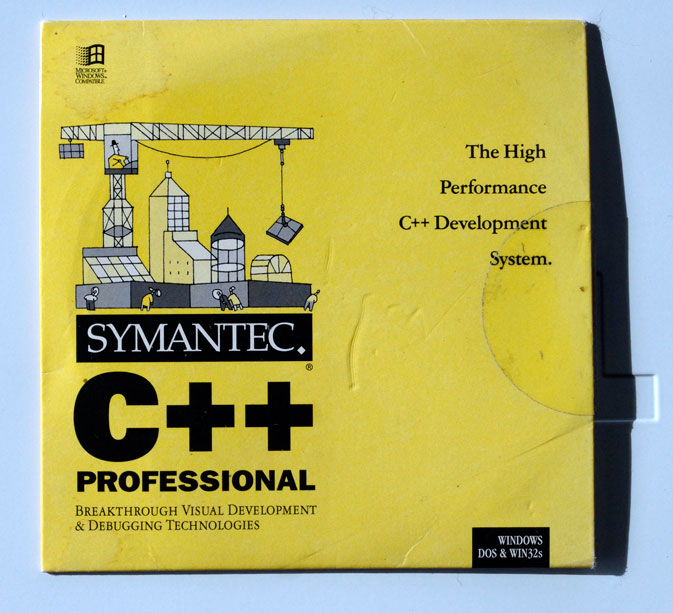
CD of the Symantec C++ Windows + DOS development environment back from 1993

Original copy of Symantec C++ (née Zortech C++) 6.1

Most people these days are surprised that Symantec actually sold a C++ compiler at some point. I used this particular copy in my first, not very successful business venture - I started out using Walter Bright’s Zortech C++ compiler which eventually morphed into Symantec C++.

Timo Geusch

1-Minute Read

I’m generally more of a grep person but sometimes it’s easier to just use the built-in search in Visual Studio, especially if you want to be able to restrict the search to parts of your Visual Studio solution. Visual Studio does have pretty powerful search built in if you do use regular expressions instead of the default text matching. Here are a couple of regexes to get you started:

Find all shared_ptr calls that use “new” instead of the recommended make_shared: shared_ptr<.+>(new .+)

Timo Geusch

4-Minute Read

In my previous post, I discussed various strategies for managing third party libraries. In this post I’ll discuss a couple of techniques you can use to ensure that a specific version of your source code will get compiled with the correct version of the required libraries.

Yes, you can rely on your package management tools to always deliver you the correct versions. If you’re a little more paranoid and/or spent way too much time debugging problems stemming from mixing the wrong libraries, you may want to continue reading.

Timo Geusch

6-Minute Read

Every reasonably sized C++ project these days will use some third party libraries. Some of them like boost are viewed as extensions of the standard libraries that no sane developer would want to be without. Then there is whatever GUI toolkit your project uses, possibly another toolkit to deal with data access, the ACE libraries, etc etc. You get the picture.

Somehow, these third party libraries have to be integrated into your development and build process in such a way that they don’t become major stumbling blocks. I’ll discuss a few approaches that I have encountered in the multitude of projects I was part of, and will discuss both their advantages and problems.

Timo Geusch

2-Minute Read

Reposted from my old blog. Here’s the news from 2009…

I’m currently in the final stages of converting a library from raw pointers to boost::shared_ptr. I’m mainly doing this to ensure the correct pointer/pointee ownership rather than the outright prevention of memory leaks, but the latter is a nice side effect of the former.

One problem I ran into was that the library I’m updating and its clients make rather heavy use of polymorphism. Of course in 99% of the code that was fine as the objects were accessed through pointers to base classes, but the last 1% was causing problems because that part of the code contained lots of dynamic_cast statements. These classes unfortunately need to know the exact type they were dealing with so there was no easy way around the use of these idioms. It probably isn’t news to most of the people reading this blog that dynamic_cast and boost::shared_ptr don’t play that nicely.

Timo Geusch

4-Minute Read

I originally published this post on my old blog in 2009. I’ve edited it a little for readability but left the contents unchanged, so it may be out of date and not reflect the current state of the pantheios library. I also haven’t been using pantheios for logging since about 2010, and have been using Boost.Log instead.

I recently had to come up with a logging solution for C++ code a JNI DLL/shared library that is providing the data translation layer between Java and underlying native C and C++ libraries. As usual, some logging was required to aid fault-finding in a production environment, if necessary. A quick survey of the state of C++ logging showed that not a lot had changed since I last looked at logging libraries. In fact, a lot of them seem to have survived unchanged for several years. I’m not sure if that is a good thing and a sign of maturity or a sign of “making do” and the low priority most projects assign to a performant logging library. Eventually I settled on pantheios as it offered several features that were crucial for this application. The major one was that pantheios it is extremely modular and will only link in the parts you really need. I consider this a major advantage over the more monolithic libraries that pull in all their functionality all the time, especially when you link them in as a static library (yes, log4cxx, I’m looking at you). Linking in the logging library as a static library was necessary to avoid conflicts with other libraries that are being used in the same process.

Timo Geusch

3-Minute Read

Another slightly edited post from my old C++ blog. Again, you may have seen this one before.

This post is a quasi follow-up to the  “little exception shop of horrors”_. As I mentioned in that post, I believe the reason for dumping all the exception handling code into a single header file was a misguided attempt at avoiding code duplication. No, I didn’t write that code, so I can only speculate as to why it was done. I inherited the project that contained this code and the reasons were lost in the mists of time. I did file it under “sound idea but bad execution”. It doesn’t fix the problem and you still have code duplication as the preprocessor will do the duplication work for you. Ah well, at least to don’t have to type the code in yourself multiple times. I couldn’t help but think that there must be a better way.

Timo Geusch

2-Minute Read

This post first appeared on my old C++ blog. You might have seen it before.

I think by now we can all agree that exceptions are generally a good thing in C++. They allow us to separate the error handling from the general flow of control inside a program and also enable us to handle errors at the most appropriate point. More often than not, the best point to handle errors is quite far removed from the source of the exception.

Recent Posts

Categories

About

A developer's journey. Still trying to figure out this software thing after several decades.